
How Marketing Teams Mine Customer Voice and Competitive Intel with the Optiverse Assistant
How marketing teams use the Optiverse AI assistant to extract customer language from sales calls, gather competitive intelligence mentioned in meetings, track campaign feedback, and generate content grounded in real customer conversations.
The best marketing copy uses words customers actually say. The strongest competitive positioning comes from what buyers tell your sales team. The most effective campaigns address real pain points, not assumed ones. All of this data lives in your organization's meetings. The Optiverse assistant lets you access it without attending a single sales call.
Mine Customer Language from Real Conversations
Focus groups and surveys give you polished answers. Sales calls give you raw, honest language. The way a prospect describes their problem in a sales call is exactly how you should describe it in your marketing.
What to ask:
- "What words do prospects use to describe their biggest challenge when evaluating our product?"
- "How do customers describe the value they get from us in their own words?"
- "What phrases do buyers use when talking about the problem we solve?"
- "What analogies or comparisons do prospects make when explaining their current situation?"
What you get:
- Direct quotes from real conversations
- The emotional language buyers use (frustration, relief, excitement)
- The specific outcomes they care about, in their words
- Patterns in how different buyer personas frame the same problem
How to use it:
- Pull customer quotes for landing page headlines
- Use their exact phrasing in email subject lines and ad copy
- Build case study narratives using language the customer already used
- Validate (or invalidate) your current messaging against how buyers actually talk
This is voice-of-customer research without the research project. One query gives you what would normally require weeks of interviews and analysis.
Competitive Intelligence from Sales and CS Calls
Competitors come up naturally in sales conversations. Prospects compare you, ask how you're different, mention what they liked or disliked about alternatives. This is the most honest competitive intelligence you'll ever get.
What to ask:
- "What have prospects said about [competitor] in the last quarter?"
- "What reasons do prospects give for considering us over [competitor]?"
- "When buyers mention [competitor], what specific features or capabilities do they reference?"
- "What did prospects say they disliked about their current solution before evaluating us?"
- "How do buyers describe the difference between us and [competitor]?"
What this gives you that review sites don't:
- Unfiltered buyer perceptions (not curated reviews)
- Specific feature comparisons from people actively evaluating both products
- The actual language buyers use to differentiate you from competitors
- Objections that only surface in live conversations
- Trends over time (is a competitor getting mentioned more or less?)
Practical workflow:
- Run a quarterly competitive query across all sales meetings
- Ask the assistant to identify the top mentioned competitors and the context
- Pull specific quotes that reveal positioning gaps or opportunities
- Feed findings into your competitive battlecard updates and messaging docs
Track Campaign and Messaging Feedback
When sales reps present marketing materials to prospects, the feedback gets captured in the meeting recording. The assistant surfaces this feedback so you can iterate on messaging in real time.
What to ask:
- "What feedback has the sales team given about the new positioning in their calls this month?"
- "Have any prospects mentioned our recent case study, webinar, or content?"
- "When reps present the new deck, what questions do prospects ask?"
- "What parts of our messaging resonate most based on prospect reactions in calls?"
- "Which claims in our materials have prospects pushed back on?"
Closing the feedback loop:
Marketing creates content. Sales uses it. Prospects react to it. But that reaction data rarely makes it back to marketing. The Optiverse assistant closes this loop automatically by searching across all sales conversations for mentions of your materials, messaging, and campaigns.
Generate Content Grounded in Customer Voice
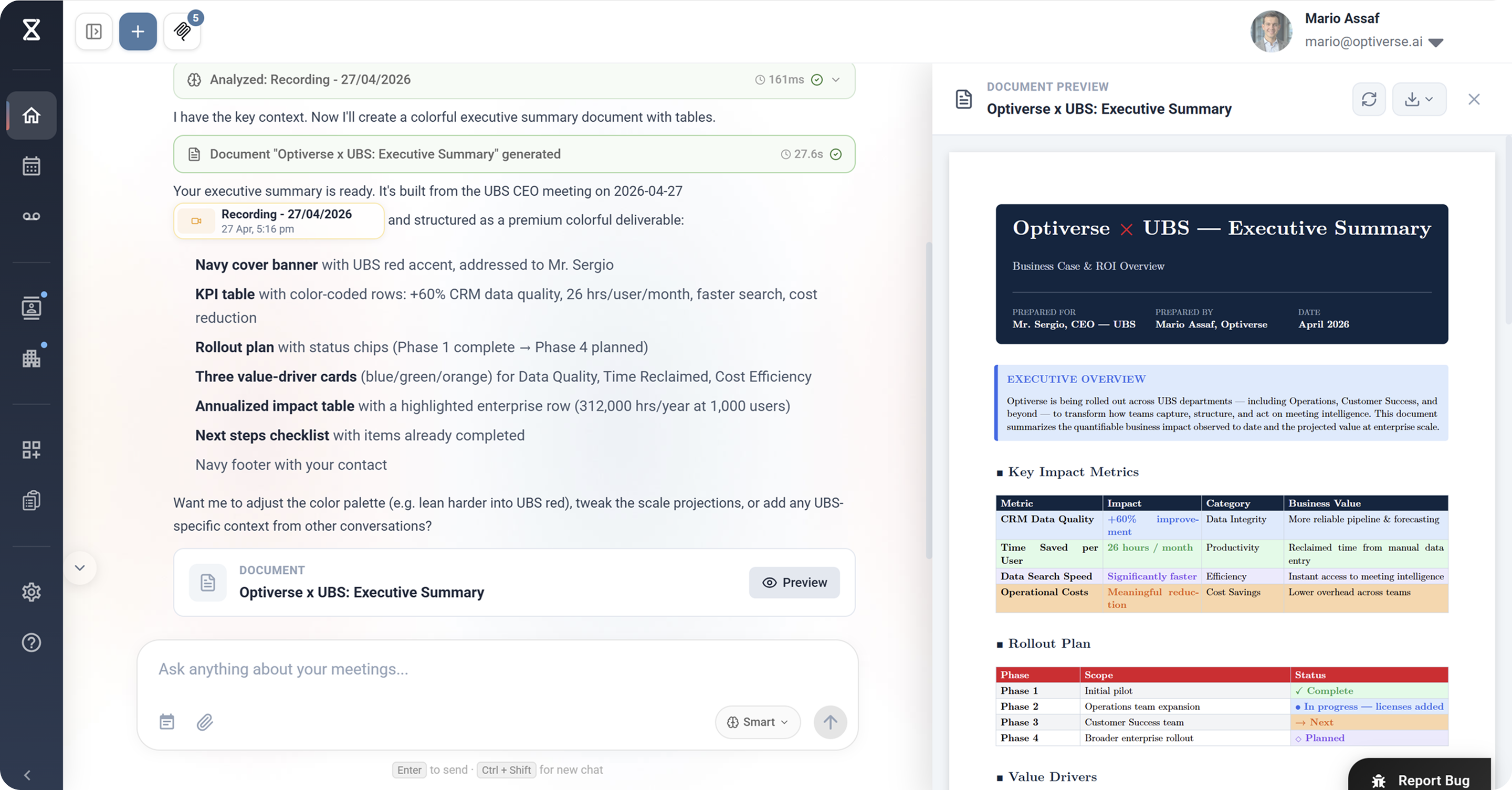
Content that's grounded in real conversations outperforms content written from assumptions. The assistant helps you create briefs, outlines, and drafts that use actual customer language and real pain points.
What to ask:
- "Generate a blog outline about data migration challenges using the pain points customers mentioned in sales calls this quarter"
- "Draft messaging for the new analytics feature using language customers have actually used when requesting it"
- "What are the top 5 outcomes customers describe getting from our product? Use their exact words."
- "Create a content brief about [topic] based on questions prospects frequently ask in discovery calls"
What makes this effective:
- Content addresses problems people actually have (not problems you assume they have)
- Headlines and hooks use language the audience already uses
- Proof points come from real customer quotes, not fabricated testimonials
- SEO benefits from matching the actual search language buyers use
Collaborate with Sales on Positioning
The gap between what marketing says and what sales hears in the field is one of the biggest sources of misalignment. The assistant bridges this gap with data.
What to ask:
- "Compare what our marketing materials say about [feature] with how prospects react to it in calls"
- "What questions do prospects always ask that our materials don't answer?"
- "Which value propositions does the sales team use most often in their pitches?"
- "What language does the sales team use to describe our product that differs from our official messaging?"
How to use these insights:
- Update marketing materials to address the questions prospects actually ask
- Align official messaging with the pitch language that's working for sales
- Create enablement content that fills gaps the sales team has identified
- Remove claims or positioning that prospects consistently push back on
Example Prompts for Marketing Teams
| What you need | What to ask the assistant |
|---|---|
| Voice of customer | "What exact words do prospects use to describe the problem we solve?" |
| Competitive positioning | "What do buyers say about [competitor] vs. us in sales calls?" |
| Campaign feedback | "Have prospects or reps mentioned our [campaign/content] in recent calls?" |
| Content ideas | "What questions do prospects ask most frequently in discovery calls?" |
| Messaging validation | "When reps present our value prop, what resonates and what falls flat?" |
| Case study material | "What outcomes has [customer] described achieving? Pull direct quotes." |
| SEO research | "What language do buyers use when describing their need for a product like ours?" |
| Sales enablement gaps | "What questions does the sales team struggle to answer based on recent calls?" |
| Persona research | "How do different buyer roles (VP vs. Director vs. IC) describe the same problem?" |
| Win/loss analysis | "In deals we lost, what reasons did prospects give for choosing the competitor?" |
Workflow Tips
- Run monthly voice-of-customer queries. Pull fresh language from recent sales calls every month. Customer language evolves, and your messaging should evolve with it.
- Attend fewer calls, search more. You don't need to shadow sales calls to understand buyers. Search across hundreds of conversations in seconds.
- Build a living competitive file. Update your competitive intelligence quarterly by asking what prospects have said about each competitor.
- Connect content to pipeline. Search for which content pieces get mentioned in winning deals vs. losing deals to understand what actually influences buyers.
- Share findings with sales. Run queries that benefit both teams. When marketing and sales work from the same customer language, alignment happens naturally.
Get Started
You don't need to attend sales calls to access the insights inside them. Once your sales and CS teams are recording with Optiverse, you can search across their conversations from the homepage.
- Create your free account (Google or Microsoft sign-in)
- Make sure recordings from sales and CS calls are shared with you or your workspace
- Open Multi-Meeting Search on the homepage and start querying customer conversations
- Try a voice-of-customer query to see the immediate value
Setup takes under 5 minutes. The real unlock for marketing comes when your organization has a library of customer conversations. Every recorded call becomes a source of authentic voice-of-customer data.
Want to see how Optiverse gives marketing teams access to buyer conversations? Book a short call and we'll show you live.
Multi-Client Meeting Management and Proposal Generation for Consultants | Optiverse
How consultants and agencies use the Optiverse AI assistant to maintain full context across multiple clients, generate proposals from discovery calls, track commitments per engagement, and prepare for client meetings instantly when juggling many accounts.
Comparisons
See how Optiverse compares to other AI meeting assistants.