
Attio Integration
Connect Optiverse to Attio to automatically sync meeting notes, map protocol data to custom objects, and manage your CRM with natural language.
Optiverse integrates with Attio to automatically log meeting summaries to your contacts, deals, and people records, with the added flexibility of mapping structured protocol data directly to Attio's custom object structure. Combined with a powerful 31-tool MCP integration, Optiverse gives you bilateral access to your entire Attio workspace through natural conversation.
Attio's flexible, data-model-first approach to CRM pairs naturally with Optiverse's protocol system. Where other CRMs have rigid object structures, Attio lets you build custom objects and attributes. Optiverse's field-by-field mapping feeds structured meeting intelligence directly into those custom structures after every call.
Part 1: Native Attio Integration
The native integration handles automatic data flow from Optiverse into Attio. Meeting summaries, new contacts, and structured protocol data push to your Attio records without manual work.
Connecting Attio
- Go to Settings > Integrations
- Find Attio under the CRM category
- Click Connect
- Authenticate with your Attio workspace in the popup window
- Once connected, the status changes to Connected and ready
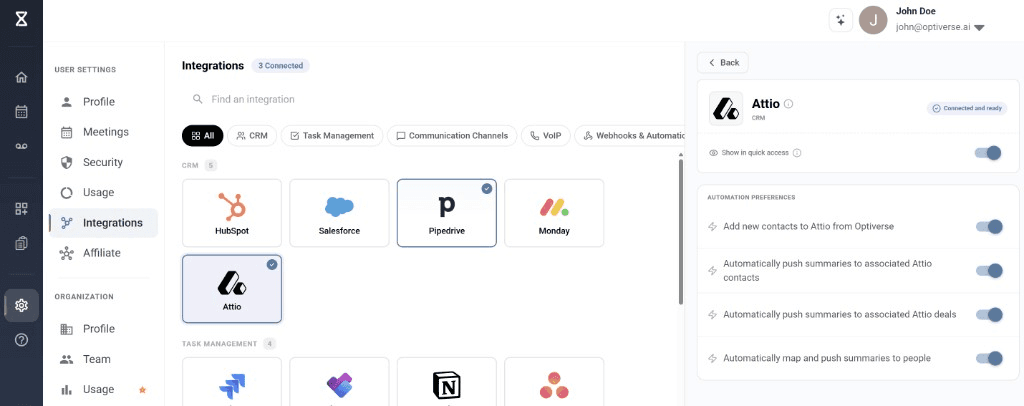
Each user connects their own Attio account. The integration respects Attio workspace permissions, so it only accesses records the authenticated user can view and edit.
Automation Settings
After connecting, you configure four automation preferences that control what happens after every meeting.
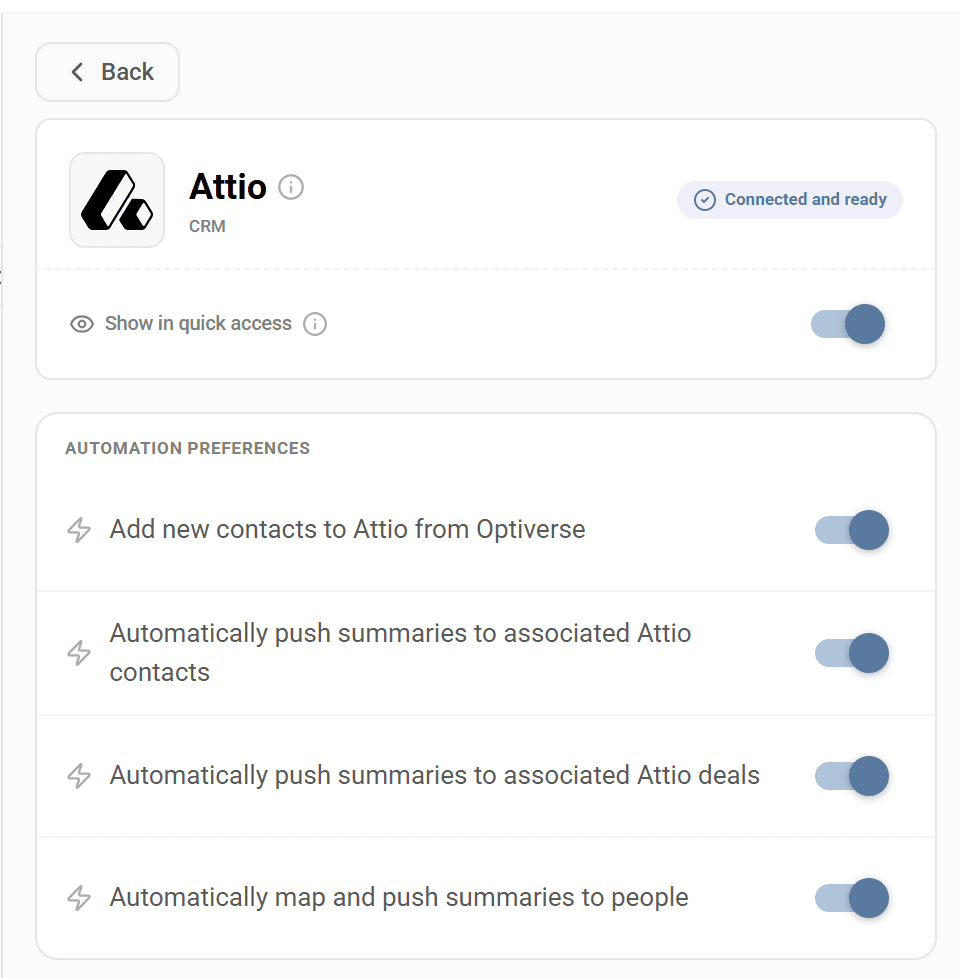
Show in Quick Access
Enables the Attio icon on every Meeting Recording page, next to the Share button. This lets you manually push the currently displayed meeting notes to any Attio deal at any time.
Add New Contacts to Attio from Optiverse
Optiverse reads attendee email addresses from your calendar invites. When this setting is enabled, if a meeting attendee does not already exist as a contact in Attio, Optiverse automatically creates a new person record for them.
Automatically Push Summaries to Associated Attio Contacts
After every meeting, Optiverse pushes the meeting summary as a note under the matched contact records in Attio. Matching is based on attendee email addresses from the calendar invite.
Automatically Push Summaries to Associated Attio Deals
The meeting summary is also pushed to any open deals associated with the matched contacts. This keeps your deal timeline current with every customer conversation.
Automatically Map and Push Summaries to People
This option takes the integration a step further. Instead of just logging a note, Optiverse maps your protocol's structured output directly to attributes on the person record in Attio. Each section of your protocol can map to a specific Attio attribute, turning unstructured meeting conversations into structured data on your people records.
Which Summary Gets Pushed?
The note that is automatically pushed to Attio is the output of your default protocol. Each user selects one protocol as their default on the Protocols page, and that protocol generates the meeting summary that flows into Attio after every call.
If you want a different protocol's output pushed to a specific deal, use the manual push via the Attio Quick Access icon after switching to the desired protocol on the recording page.
Custom Object and Attribute Mapping
Attio's strength is its flexible data model. You define your own objects, attributes, and relationships. Optiverse maps directly into that structure.
When you enable the mapping options, each section of your protocol template can push its output to a specific Attio attribute on any object type:
- Protocol sections with text output map to text attributes
- Protocol sections with number output map to number attributes
- Protocol sections with list output map to multi-select or text attributes
- Protocol sections with predefined options map to select attributes
This means your meeting data doesn't just land as a blob of text in an activity note. It arrives as structured, queryable, reportable data inside Attio's native object model.
Attio's custom objects give you full flexibility. If you've built custom objects for tracking deal qualifications, customer health scores, or project milestones, Optiverse can push structured data directly into those objects after every meeting.
How Auto-Matching Works
The integration uses a straightforward matching process:
- Optiverse reads attendee emails from your calendar invite
- Emails are matched against existing Attio person records
- Associations are followed from people to their linked deals and companies
- Summaries are pushed as notes and/or mapped attributes to all matched records
For the best matching accuracy, ensure your Attio people records have email addresses that match what attendees use in their calendar invitations.
Manual Push from the Recording Page
When Show in Quick Access is enabled, the Attio icon appears at the top of every Meeting Recording page.
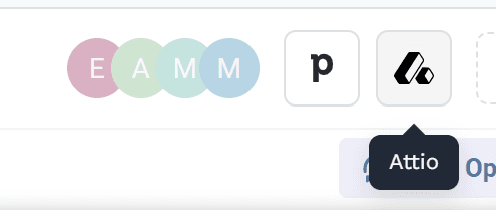
Click the icon to open the push dialog:
- A deal selector lets you choose which deal to push the notes to
- A summary preview shows the protocol output that will be pushed (formatted, with word count)
- Click Push to Attio to send the notes
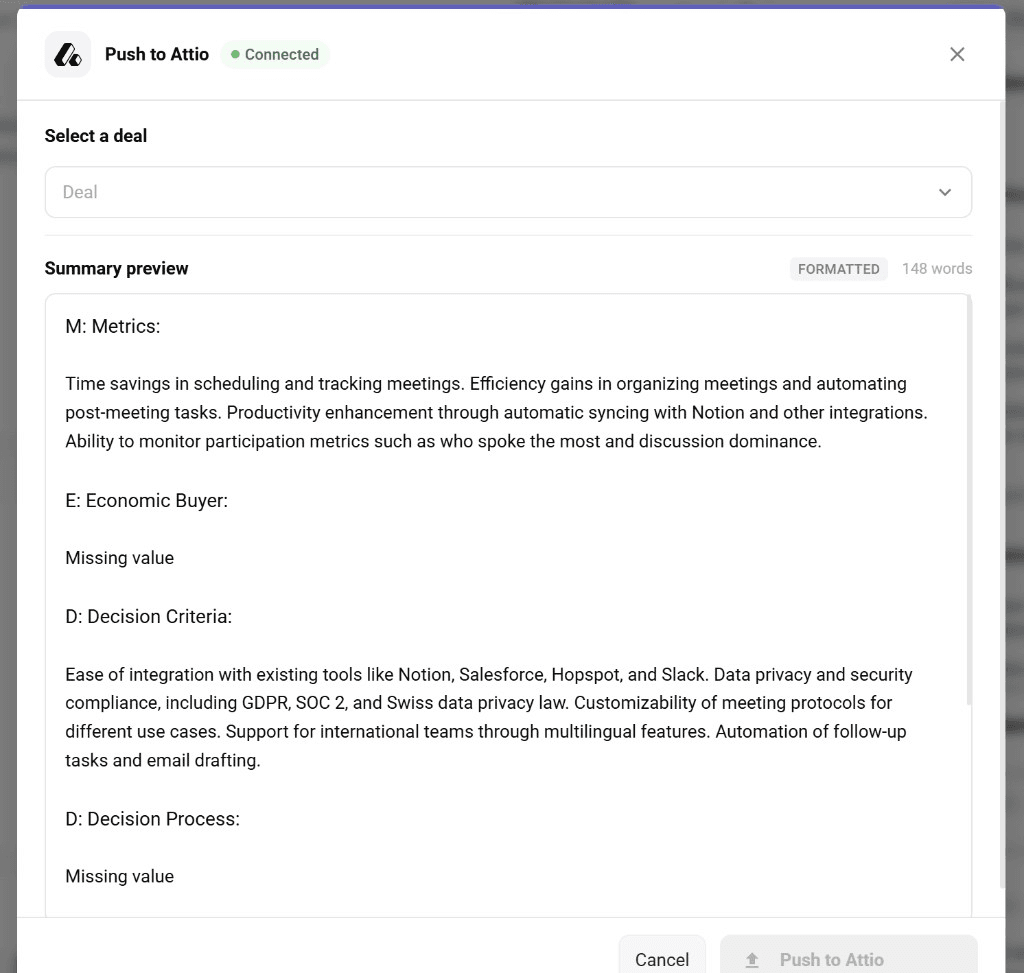
When Manual Push Is Essential
Automatic matching relies on attendee email addresses from calendar invites. Manual push fills the gap for situations where that matching cannot happen:
- On-site visits documented afterward using the Optiverse mobile app
- Voice memos recorded on the go to capture client conversations
- In-person meetings without a calendar event containing attendee emails
- Meetings with attendees whose emails aren't yet in Attio
In all these cases, you can still push with one click by selecting the right deal manually. You can also ask the AI assistant on the homepage to push it for you via the MCP integration.
For quick dictations captured on the go with the mobile app, record your thoughts after the meeting. Then push the resulting notes to the right Attio deal either manually or by asking the AI assistant.
Part 2: MCP Integration (Bilateral Access)
The native integration pushes data from meetings to Attio. The MCP integration opens the reverse direction: the Optiverse AI assistant can search, read, create, update, and manage your entire Attio workspace through natural language.
With 31 available tools, the Attio MCP integration is the most comprehensive CRM connection Optiverse offers. It covers records, lists, notes, tasks, and custom objects.
Connecting the MCP Integration
- On the Optiverse homepage, click the MCPs tab in the top left
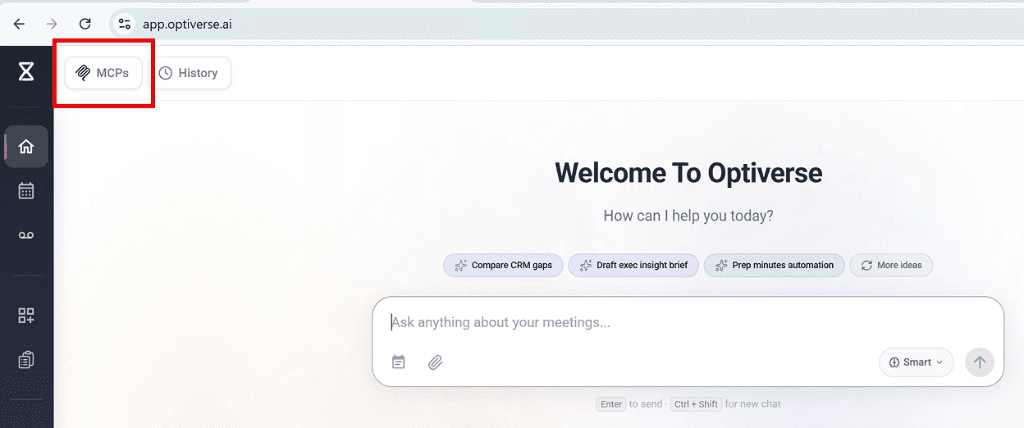
- In the MCP Integrations popup, search for Attio and click Connect
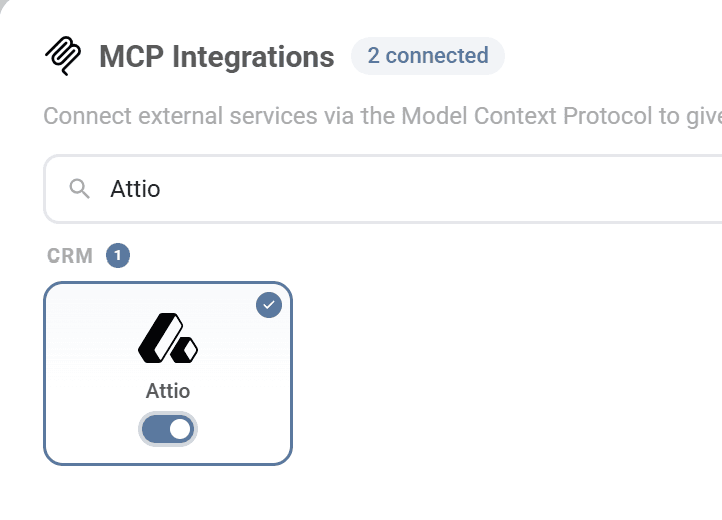
- The connection re-uses your OAuth tokens from the native integration (no separate authentication required)
- Once linked, you'll see all 31 available tools and permission controls
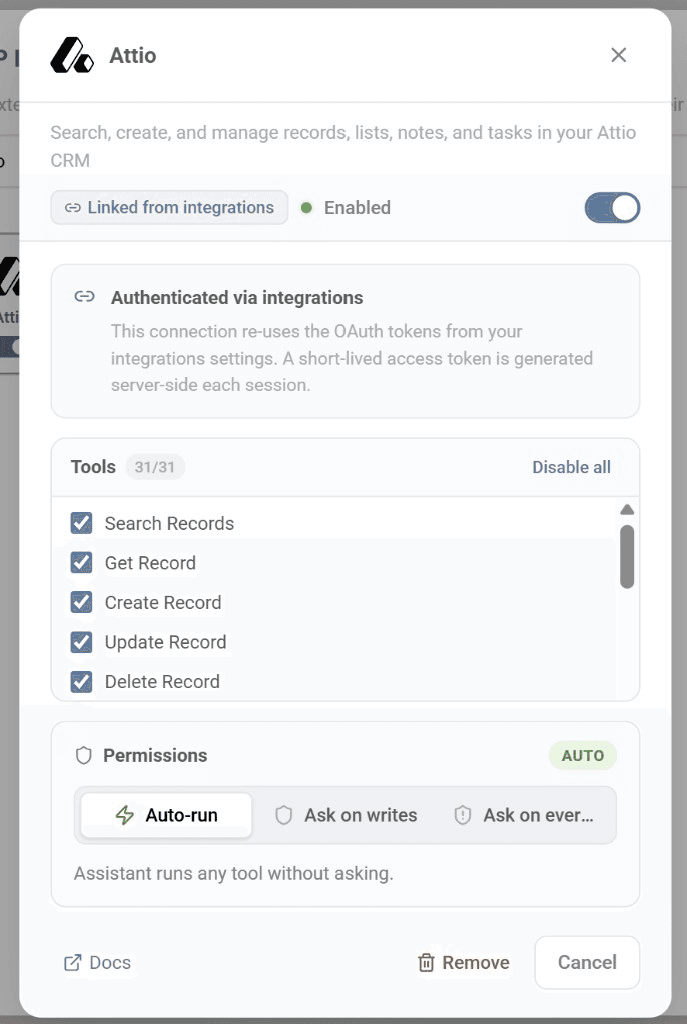
The MCP connection is authenticated via your existing integration settings. A short-lived access token is generated server-side each session for security.
Available Tools (31 Total)
The Attio MCP integration gives the AI assistant the broadest access of any CRM connection:
| Tool | What it does |
|---|---|
| Search Records | Find any record across all object types |
| Get Record | Retrieve full details on a specific record |
| Create Record | Create new people, companies, deals, or custom objects |
| Update Record | Modify attributes on any record |
| Delete Record | Remove records (with permission controls) |
| List Records | Browse records in any object or list |
| Search Notes | Find notes across your workspace |
| Create Note | Add notes to any record |
| List Tasks | View tasks across deals and people |
| Create Task | Create new tasks with deadlines and assignees |
| Update Task | Modify task status, deadline, or assignment |
| List Lists | View all custom lists in your workspace |
| Get List Entries | Browse entries in a specific list |
Permission Modes
You control how much autonomy the AI assistant has when interacting with Attio:
| Mode | Behavior |
|---|---|
| Auto-run | The assistant executes any tool without asking. Best for power users who trust the workflow. |
| Ask on writes | The assistant reads freely but asks permission before creating, updating, or deleting records. Recommended for most users. |
| Ask on every action | The assistant requests consent at every step, including read operations. Most conservative. |
Use Cases for Modern Sales Teams
Attio users tend to value flexibility and data structure. The combination of Optiverse's protocol system and Attio's custom objects creates workflows that are far more powerful than basic meeting note logging.
Cross-Reference Deals with Recent Meetings
Validate that your Attio deals reflect the reality of what was discussed in recent customer conversations.
Example prompt:
"Can you list my last three deals in Attio and check if I have met these clients in the last week?"
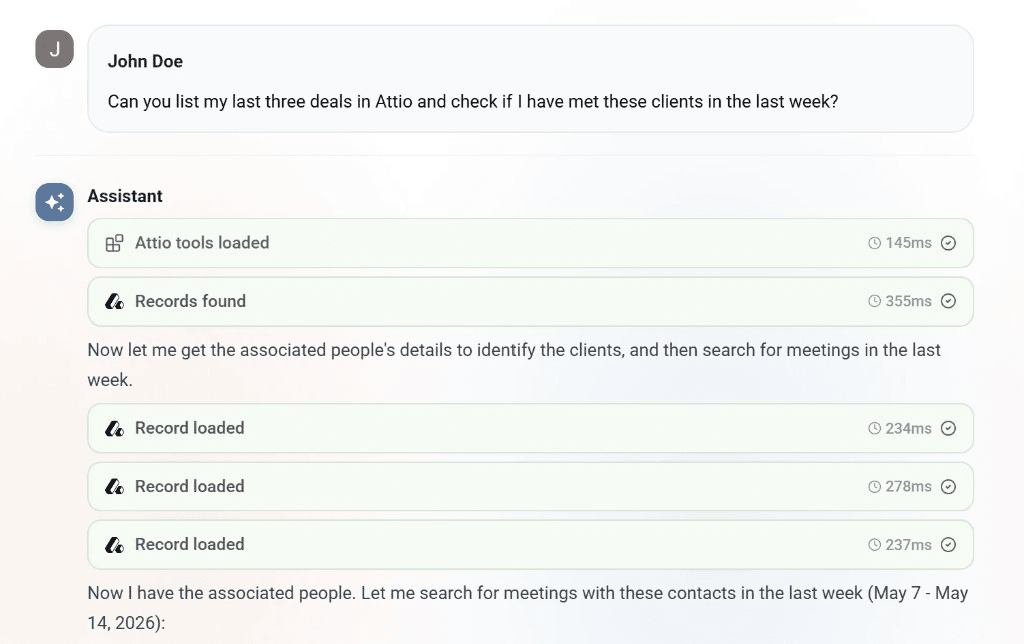
The assistant loads your recent deals from Attio, identifies the associated people, searches for meetings with those contacts in the specified timeframe, and reports back with a clear picture of which deals have had recent engagement and which haven't.
Build Structured Deal Qualification Data
Attio's custom attributes are designed to hold structured data. Optiverse's protocol system extracts that data from conversations. Together, they create an automated qualification engine.
After every discovery call, your MEDDPICC or BANT protocol extracts qualification criteria. The mapping pushes each criterion to the corresponding attribute on the deal in Attio. Over time, this builds a complete qualification picture without any manual CRM entry.
Example prompts:
- "For my deals in the 'Discovery' stage, which ones are missing key qualification data?"
- "Show me all deals where the economic buyer hasn't been identified yet."
- "Which deals have complete MEDDPICC data based on our meeting notes?"
Keep Pipeline Stages Aligned with Conversations
Deal stages should reflect what's actually happening with the customer. Use meeting intelligence to verify Attio pipeline data.
Example prompts:
- "Based on my last ten client meetings, are all deal stages in Attio still accurate?"
- "Which deals should have progressed based on what was discussed this month?"
- "Flag any deals where the stage hasn't changed in two weeks but we've had active meetings."
Prepare for Calls with Full CRM Context
Drag and drop an upcoming meeting into the Optiverse homepage chat. With the Attio MCP connected, the briefing includes live deal data, people attributes, and notes from Attio alongside your meeting history.
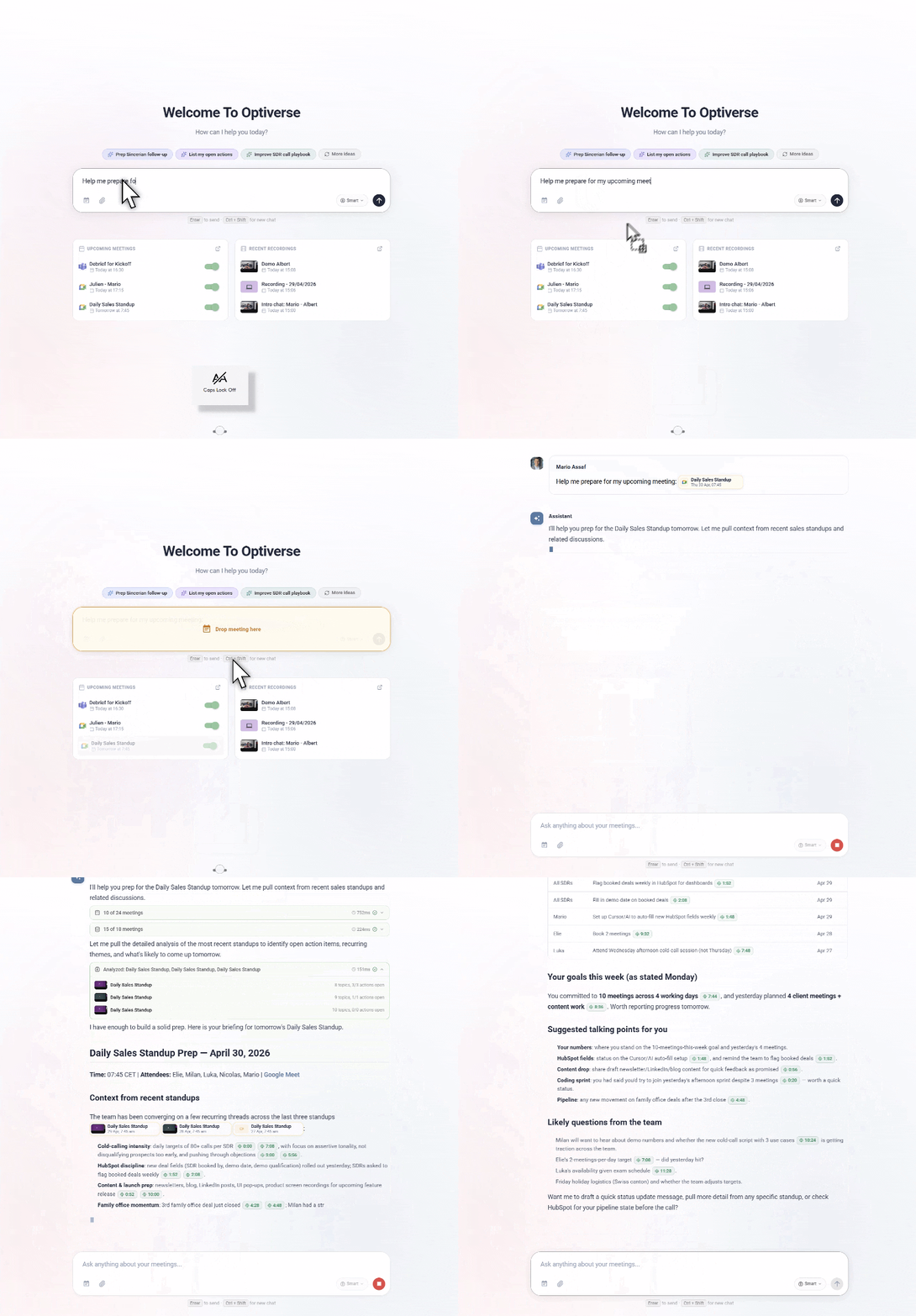
Example prompts:
- "I have a call with [company] in 10 minutes. Pull their Attio deal details, last meeting notes, and open tasks."
- "What attributes do we have on the [company] deal? What did we last discuss and what should I focus on?"
- "Show me all people associated with [company] and our recent interactions with each."
Populate Custom Objects from Meeting Data
If you've built custom objects in Attio for use cases like customer health tracking, competitive intelligence, or project milestones, Optiverse can populate them directly from meeting discussions.
Example prompts:
- "After today's call, update the customer health score for [company] in Attio based on the sentiment of our discussion."
- "Create a new entry in my 'Competitive Mentions' list for the competitor discussed in today's meeting."
- "Add a milestone to the [company] deal based on the commitment they made today."
Automate Contact Enrichment
Attio thrives on rich contact data. Optiverse captures details about people during meetings (their role, priorities, concerns, communication style) that can flow into Attio as structured attributes.
Example prompts:
- "Which meeting attendees from this month don't have a person record in Attio yet? List them."
- "Update the contact notes for [person] based on what they said in today's call about their priorities."
- "For all new contacts created this week, add notes about their role and what they care about based on our meetings."
Manage Tasks and Follow-ups from Conversations
Every meeting generates next steps. Use the MCP to create tasks directly in Attio from what was discussed.
Example prompts:
- "Create tasks in Attio for all action items from today's client meetings."
- "What open tasks do I have in Attio for [company]? Have any been addressed in our recent meetings?"
- "Schedule a follow-up task for [person] based on the timeline they mentioned in our call."
Generate Pipeline Intelligence Reports
Combine meeting insights with Attio data to create reports that capture what's truly happening in your pipeline.
Example prompts:
- "Give me a pipeline review: for each deal in 'Negotiation', show the last meeting date and what was discussed."
- "Which deals closing this month have had positive recent meetings? Which seem at risk?"
- "Summarize all client conversations from this week and which Attio deals they relate to."
Audit Data Completeness Across Objects
Attio's flexibility means there are often many attributes to keep current. Use Optiverse to identify gaps between what was discussed in meetings and what's actually recorded.
Example prompts:
- "Which people records are missing attributes that were discussed in recent meetings? (role, budget authority, timeline)"
- "For deals in my pipeline, which ones have empty fields that should be filled based on our conversations?"
- "Compare what we know from meetings about [company] versus what's currently in their Attio record."
Example Prompt Library
| Category | Prompt |
|---|---|
| Deal Validation | "List my last three deals in Attio and check if I have met these clients in the last week." |
| Pipeline Review | "For each deal in 'Proposal' stage, show the last meeting summary and next steps from Attio and meetings." |
| Meeting Prep | "I'm meeting with [company] tomorrow. Pull their Attio deal info, people records, and my last meeting notes." |
| Task Creation | "Create follow-up tasks in Attio for all action items from today's calls." |
| Contact Enrichment | "Which meeting attendees from this month don't exist in Attio yet? Add them with their role and company." |
| Custom Object Updates | "Update the health score for [company] in Attio based on today's conversation." |
| Stage Accuracy | "Based on recent meetings, which deal stages in Attio need to be updated?" |
| Forecasting | "Which deals closing this quarter have had recent positive meetings? Which are at risk based on conversation sentiment?" |
| Activity Gaps | "Which deals haven't had a logged meeting in over two weeks? List them with their current stage." |
| Competitive Intel | "Which competitors were mentioned across my client meetings this month? Map them to the relevant Attio deals." |
Troubleshooting
| Issue | Solution |
|---|---|
| Integration not syncing | Click Reconnect in Settings > Integrations > Attio to refresh authentication |
| Contacts not matching | Verify that attendee emails in calendar invites match the email attribute on Attio people records |
| Notes not appearing on deals | Ensure the person is properly associated with the deal in Attio |
| Mapping not populating attributes | Check that the protocol section data types match the expected Attio attribute types |
| MCP not finding records | Check that your Attio user has access to the objects and lists you're querying |
If you disconnect and reconnect the integration, your automation preferences and attribute mappings will reset to defaults. Reconfigure them after reconnecting.